
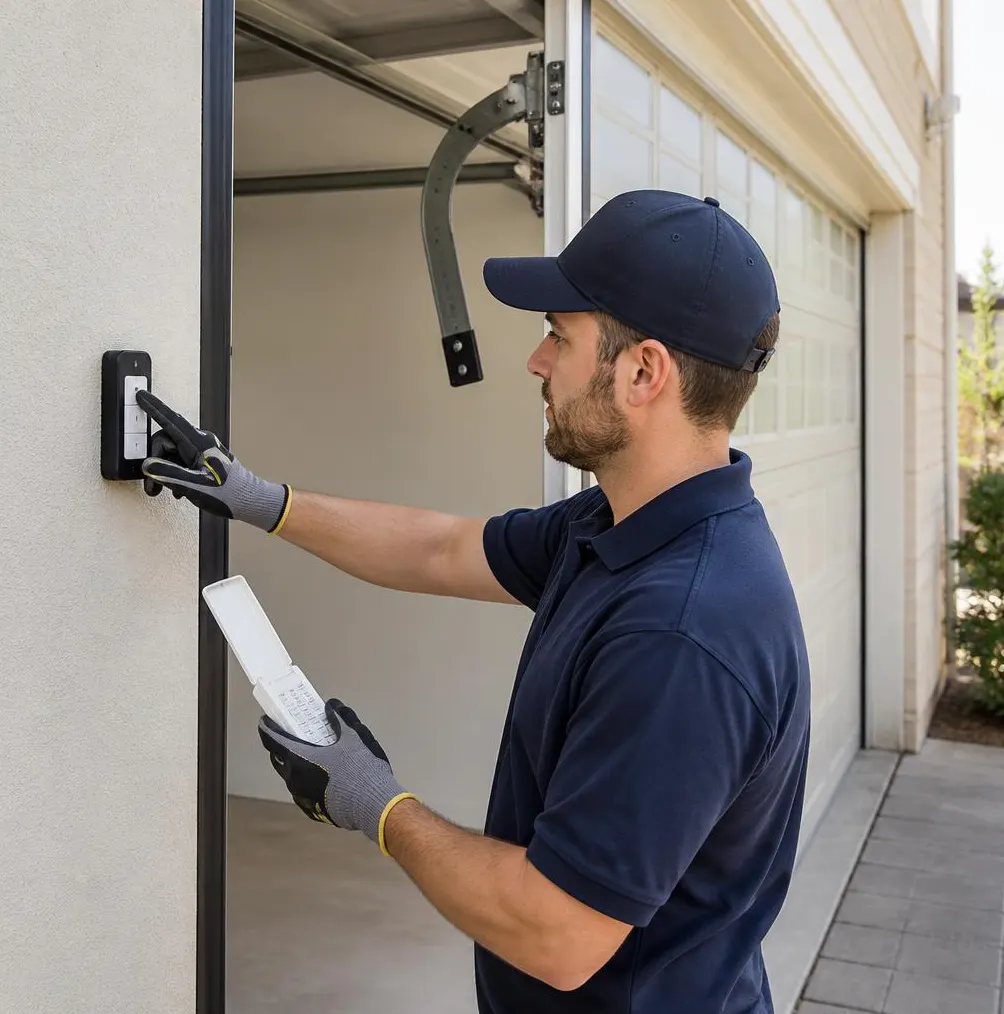
You hit the remote on your way out and the opener grinds, hesitates, then finally lifts the door — a half-second later than it used to. Or maybe it just clicks and does nothing at all. You stand there in the garage running the math in your head: is this a quick fix, or is this thing on its way out for good?
That moment is where most homeowners start guessing. Here's how to actually work through it.
What Usually Goes Wrong First
Garage door openers fail in fairly predictable stages, and most of them are repairable on their own:
- Remote or keypad stops responding reliably — often a battery, programming, or interference issue, sometimes a worn transmitter.
- Safety sensors act flaky — dust buildup from dry-season conditions or a knocked-out-of-alignment eye near the floor.
- Chain or belt noise and slack — drive mechanism wear, usually fixable with adjustment or a drive component swap.
- Motor runs hot or trips out — more common on older units during hot inland stretches when the garage itself heats up.
- Circuit board failure — intermittent operation, random reversing, or the unit not responding to anything at all.
The first three are usually inexpensive, straightforward repairs. The last two are where the decision gets real, because a circuit board or motor replacement can cost close to half of what a new opener installed would run.
Repair: The Case For It
If your opener is under 8-10 years old and the failure is isolated — a sensor, a remote, a worn gear, a capacitor — repair is almost always the cheaper call in the short term. Typical national ranges for opener repairs run roughly $100–$300 for sensor, remote, or gear issues, and $150–$350 if a circuit board needs replacing. You keep the opener you know, you avoid an install appointment, and if the rest of the unit is sound, you get more years out of it for a fraction of replacement cost.
The trade-off: you're repairing a system that's already aging. Chain-drive openers from the pre-2015 era weren't built with rolling-code security, battery backup, or the quieter belt mechanisms now standard. A repaired 12-year-old opener still behaves like a 12-year-old opener — it just works again.
Replace: The Case For It
If the unit is already in that 10-12+ year range, or you're looking at a second or third repair in a few years, replacement starts to win on total cost. A new opener installed typically runs in the $400–$700 range nationally, depending on horsepower, drive type, and features. What you get for that:
- Battery backup — genuinely useful during winter storm outages when the power drops and you still need the door to open.
- Quieter belt-drive operation — worth it if the garage shares a wall with a bedroom or living space, common in many local floor plans.
- Rolling-code security — closes a real vulnerability that older fixed-code remotes have.
- Smart connectivity — lets you confirm the door closed from your phone, handy if you're the type who second-guesses yourself halfway down the street.
- Better heat tolerance — newer motors handle sustained inland summer heat in an enclosed garage more reliably than older units that weren't designed for it.
The trade-off is upfront cost and an install appointment, plus matching the new opener to your existing door's weight and spring setup, which a tech should verify rather than assume.
The Five-Year Math
Here's the side-by-side that actually matters:
- Opener under 8 years, single isolated failure: Repair. You'll likely spend $100–$350 once and get several more years of normal service.
- Opener 8-12 years, second repair in under 3 years: This is the break-even zone. Add up what you've already spent on repairs — if it's approaching $200-300, replacement starts to pencil out better over five years, especially once you factor in the newer safety and security features you're not getting from a repaired old unit.
- Opener over 12 years, motor or board failure: Replace. Parts availability gets thinner, and you're paying near-replacement cost to keep an outdated unit limping along.
- Multiple minor issues (remote, sensor, noise) on an otherwise young unit: Repair each as they come up. There's no reason to replace a 5-year-old opener over a $40 sensor.
For typical homes in this area — a garage that swings from cool mornings to hot, dusty afternoons for several months a year, sometimes with occasional winter power blips — the honest recommendation is: repair anything under about 8 years old without hesitation, and treat anything past the 10-12 year mark as a replacement candidate the moment a second real failure shows up, rather than waiting for a third.
When to Call Escondido Garage Door
If you're standing in the garage trying to decide which bucket your opener falls into, that's exactly the call to make before spending money either way. We'll diagnose what's actually failing, tell you honestly whether it's a repair or a better long-term replacement, and handle either one — our Garage Door Opener Repair & Installation service covers both quick fixes and full upgrades, matched correctly to your door's size and spring setup. If the issue turns out to be electrical or safety-related and you need it sorted the same day, our Emergency Garage Door Service is available for exactly that.
If your opener in Escondido, San Marcos, Valley Center, Rancho Bernardo, Vista, Fallbrook, Poway, or Ramona is acting up, give Escondido Garage Door a call — we'll tell you straight whether it's worth fixing or time to upgrade.